

Tropical Bouquets: Flowers with Character, Seasonality, and Vase Life
A tropical bouquet is easy to picture too literally: big leaves, orange flowers, a riot of greenery, and the feeling of a holiday somewhere by the ocean. Modern floristry treats the theme with more subtlety. An arrangement can be white, wine-dark, powder pink, or almost monochrome – and still give itself away through unusual line, dense texture, and a striking silhouette.
Anthuriums, orchids, calla lilies, and strelitzia change the usual logic of a bouquet. They don't dissolve into the mass; they shape the space around them. These are flowers worth looking at closely – they sit well in a contemporary interior and suit someone who is hard to surprise with a classic bouquet.
What a modern tropical bouquet can look like?

The defining quality of tropical floristry isn't the amount of bright colour – it's the character of the flowers. They have a pronounced form, a dense surface to the petals or spathes, long lines in the stems. Even a small mono-bouquet of anthuriums can look more convincing than a large arrangement of familiar garden flowers.
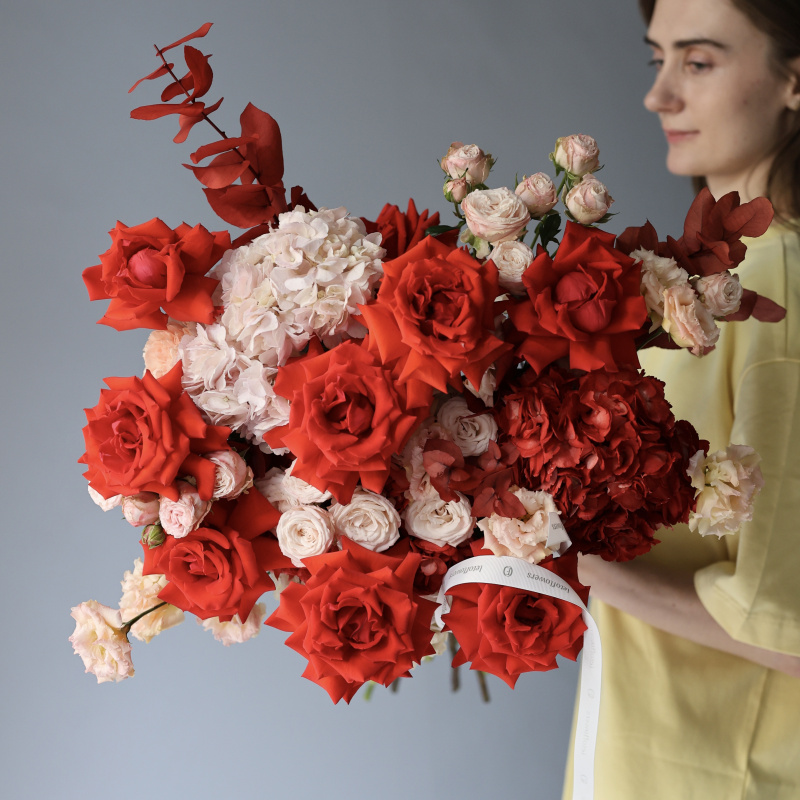
In a quiet palette, a tropical bouquet turns graphic and architectural. White orchids, green anthuriums, and dark foliage look at home beside stone, glass, wood, and pared-back furniture. Saturated reds, raspberry, and orange do something else entirely: the bouquet becomes a colour statement in its own right.
The “Tropical” bouquet shows especially clearly how exotic flowers work together: the composition isn't built around a single round volume, but on the contrast of height, curve, and large blocks of colour.
The flowers that create a tropical mood
The flowers that create a tropical mood
Anthurium: graphic form, complex colour
Anthurium: graphic form, complex colour
Anthuriums come in red, pink, white, green, burgundy, coral, and two-tone. Pale shades read more delicately, dark ones give an arrangement depth, and green ones pull even a bright bouquet together.
For a clean, contemporary gesture, a bouquet of pink anthuriums works well. A red mono-bouquet reads as bolder and more assured – especially for someone who loves an expressive detail. For something livelier and freer, there's a bouquet of anthuriums in mixed colours.
Orchids: presence without weight
The cymbidium is particularly interesting. A single stem carries several flowers at once, so an arrangement gains volume while keeping a clear pattern. A bouquet of cymbidium orchids works as a gift in its own right, when you want something exotic without a full-on tropical statement.
White orchids work beautifully in an interior. Paired with clear glass they look light and calm, and never argue with what's around them. For a home or a study, consider an arrangement of orchids in a vase.


A tropical story: callas, strelitzia, and “White Lotus”
The name of our bespoke bouquet “White Lotus” nods to the series, where flawless hotels, tropical beauty, and vivid characters add up to a world of their own – glamorous and faintly eccentric. The bouquet has a similar mood: rich in colour, cinematic, and not remotely predictable.
Wine-coloured callas and pink cymbidium lay down a deep, evening base. Orange strelitzia and callas flare against it like the sun before it sets, and tropical greenery draws the saturated palette into a single whole. The bouquet looks free and alive: the flowers open at different heights, turn in different directions, and change with every new angle.
“The White Lotus” is a mood of a bouquet, for someone who loves travel, beautiful drama, and things with character. It changes a room instantly, and looks as though it arrived in a Moscow apartment straight from the lobby of a tropical hotel.
When is the season for tropical flowers?
- Anthuriums are generally available whatever the month. That said, unusual shades – the more complex green-pink, wine, and two-tone ones – appear less predictably.
- The classic cymbidium has its strongest season from late autumn through spring. It can be available in other months too, but the choice of varieties and shades is narrower.
- The lotus is a summer flower with a short flowering window. Callas and strelitzia turn up in deliveries across different months, though it's worth checking a specific variety or shade in advance.
How long do tropical bouquets last in a vase?
How long do tropical bouquets last in a vase?
Cymbidium orchids are valued for their staying power too. The individual flowers on a stem don't age all at once, so an arrangement stays decorative for a long time.
Callas and strelitzia are more sensitive to water quality, temperature, and the stage at which they were cut.
In a mixed bouquet, always reckon with the most delicate component. If roses, delphinium, or seasonal garden flowers sit alongside anthuriums, the arrangement will change gradually. Fading stems can be removed, leaving the hardier anthuriums and orchids in the vase for longer.
What to pair with anthuriums and orchids?
The anthurium holds its own. A mono-bouquet emphasises its form and suits a contemporary interior, an opening, a professional congratulation, or a gift without too much romance. Red anthuriums look composed and confident; pink ones read more softly.
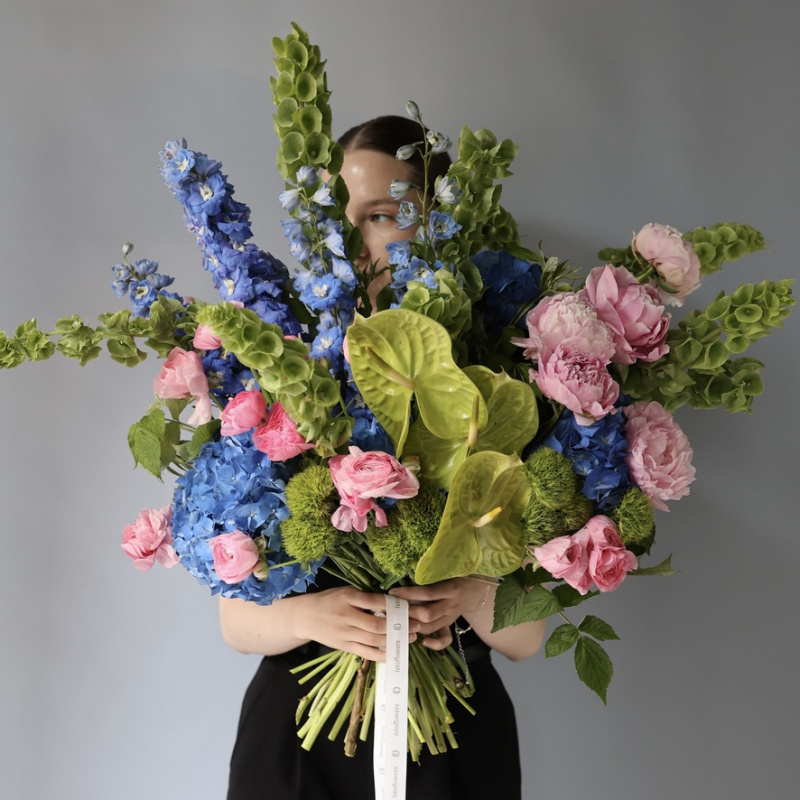
- Roses make a tropical arrangement more sensual and more familiar. Raspberry, coral, and powder shades work particularly well. In a bouquet of roses and anthuriums, the fullness of the roses softens the smooth graphic line of the anthurium, while a touch of green adds fresh contrast.
- Delphinium gives air and height. Its small flowers create a light backdrop for large orchids. A bouquet of delphinium and orchids in a vase reads cooler and calmer than a classic tropical arrangement.
- Callas strengthen the architecture, and large monstera, philodendron, or palm leaves add scale. But there shouldn't be too much greenery. When every element tries to be the lead, a bouquet quickly turns into a tropical stage set. Good bespoke work leaves the flowers room to breathe.


Occasions for a tropical bouquet
Tropical arrangements suit a birthday, an anniversary, a housewarming, or the opening of a restaurant, salon, or office. They can be given in thanks, sent after an important meeting, or chosen for the home with no occasion at all.
For a romantic gift, avoid the most severe combinations. Pink anthuriums, roses, and orchids look warmer than an arrangement of red anthuriums and large dark foliage.
For an interior, it's usually easier to send flowers already in a vase. A gift like that doesn't send anyone hunting for a suitable container – it takes its place in the room straight away.
A cut bouquet, or a rooted arrangement?
A cut bouquet, or a rooted arrangement?
An orchid with its root system is meant to stay in the home far longer. Orchids in a hat box look like a finished gift, while a glass container lets you see the roots and the structure of the plant.
For an interior with plenty of greenery, the “Tropical Mix” arrangement is a good fit. In it, orchids, callas, anthuriums, and other plants keep their roots, so the arrangement lives by the rules of houseplants rather than cut flowers.
That option works well for a housewarming, a study, a country house, or anyone who genuinely enjoys looking after plants.
How to care for tropical flowers?
Trim about a centimetre from the stem with a clean, sharp knife or secateurs, and stand the flowers in a clean vase. Change the water every two to three days, rinsing the vase and refreshing the cuts at the same time.
- AnthuriumsAnthuriums dislike real cold. Don't stand them right against an open window in winter, under air conditioning, or in ice-cold water. Direct sun, radiators, and constant handling of those dense spathes are bad for them too – the surface marks easily.
- OrchidsWith orchids, it's best not to wet the flowers themselves unnecessarily. If a single bloom loses its looks, it can be removed carefully without taking the whole arrangement apart.
- CallasCallas prefer a little water, around 5–7 cm, changed daily: their fleshy stems spoil water quickly. Refresh the cut with a sharp knife, and keep the vase away from sun and radiators.
- Rooted arrangementsRooted arrangements can't be watered on the same principle as a cut bouquet. How often depends on the plant, the substrate, and the temperature of the room. In a decorative container it's especially important not to leave the roots sitting in water.
FAQ
FAQ
You may also like