
Event Styling: A Garden That Appears for One Evening
Beautiful event styling doesn't begin with a choice of flowers. It begins with understanding the space, the shape of the evening, and the impression guests should be left with. Here's how a floral concept comes together for a wedding, a private dinner, or a gala – and how to recognise professional work when you see it.
What flowers actually do to a space?
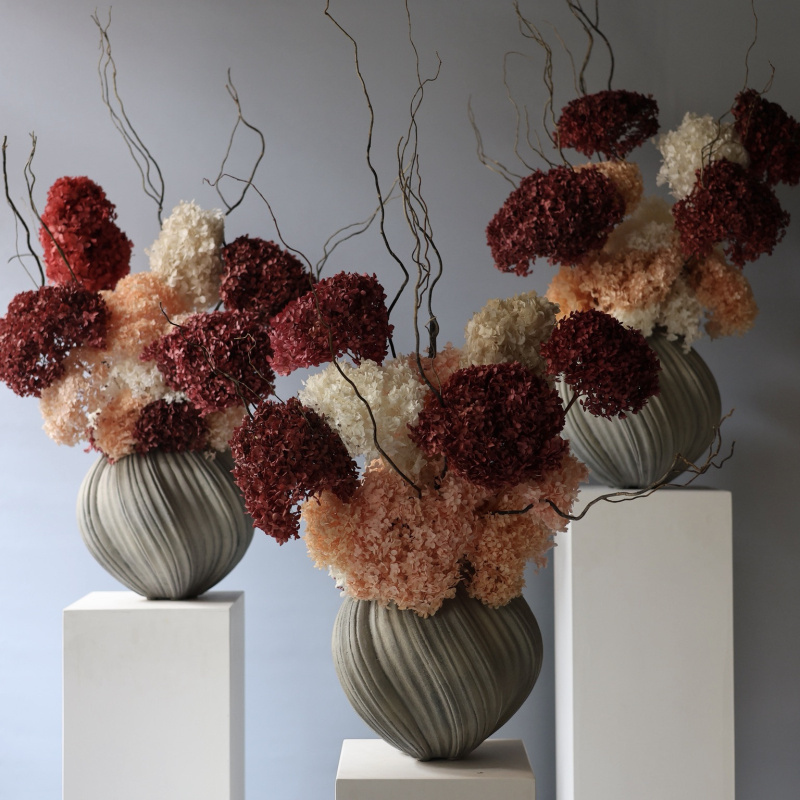
Potted plants work like stage sets in these stories, only more honestly. They give height, volume, greenery, privacy – the feeling of a garden that seems to have always been there. An olive tree in a large planter, hydrangeas by the entrance, grasses along the walkway, conifers in the evening light, and the venue stops being merely a venue. It becomes a place: the kind guests walk into and slow down a little, because it really is beautiful.
Cut flowers handle the subtler part of the performance. The colour on the tables, the mood at the bar, that one arrangement by the cake that everyone photographs, even the guests who swore there'd be no Stories tonight.
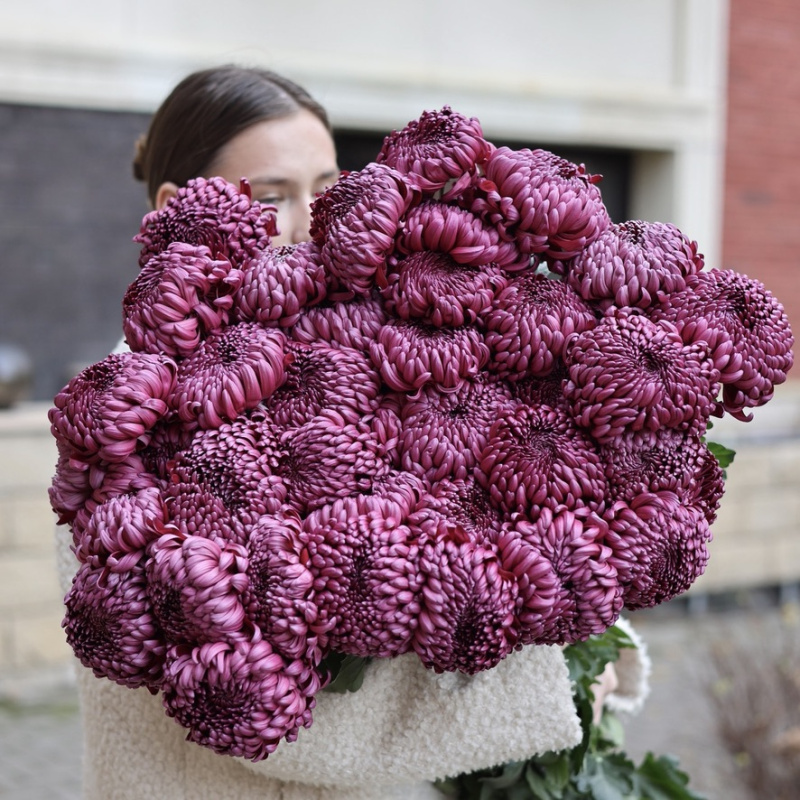
Flowers add the emotion: seasonal peonies, garden roses, sweet peas, hydrangeas, branches, grasses – something airy, something almost daring. Together it reads not as floristry delivered for a few hours, but as a space that dressed up for the occasion.
Flowers, candles, vases, textiles, and the architecture of the venue work as a single composition. Nothing looks accidental, nothing gets in the way of conversation, and nothing asks the client to keep an eye on dozens of technical details.

The questions a concept starts with
The questions a concept starts with
What's the occasion – a family dinner, a wedding, a birthday, a launch, a charity gala? How many guests? Will they be seated at one table, at several round ones, or moving freely through the room? Is there a dress code? What music will be playing? What time does the evening begin?
The character of the evening matters just as much. It can be intimate and personal, ceremonial, theatrical, light, formal, or almost domestic. Two weddings at the same venue can call for entirely different styling, because there are different people and different scripts behind them.
It's worth discussing what you definitely don't like – sometimes that list tells us more than dozens of references. For instance: no pastel romance, no classic round bouquets, no gold, no over-bright colour, nothing that feels like wedding décor.
Why a beautiful set of flowers isn't enough?
Why a beautiful set of flowers isn't enough?
Picture small round bouquets in a tall historic hall: up close they're neat, but the space swallows them. Or the reverse – tall, dense arrangements on a narrow table, behind which guests can't see one another. The flowers may be fresh and rare, but the styling isn't doing its job.
Good floristry works with proportion: ceiling height, table width, the distance between guests, how much open space there is, even the point from which most people will first see the room.
The script matters too. If guests come through a single door and find themselves at the cloakroom, a lavish arrangement at the far end of the room won't create a first impression. If the main action of the evening happens on a stage, the styling shouldn't compete with it or disappear under stage lighting.
How the venue shapes the floristry?
In a historic interior with mouldings and parquet, flowers can support the architecture rather than compete with it. Complex shades, expressive lines, and materials that sit naturally beside old wood, stone, and fabric work well here.
A contemporary hall of concrete, glass, and high ceilings often calls for something more graphic. Small, detailed bouquets can get lost, while large forms, verticals, and one clear gesture of colour can pull the space together.
In a country house or a garden, the surrounding greenery has to be taken into account. If there are already plenty of plants nearby, adding more of the same green mass doesn't always make sense. Sometimes it's better to let the floristry stand out through colour, a pale texture, or an unexpected form.
Before developing a full proposal, it helps to see the venue in person, or to receive detailed photos, video, plans, and dimensions. The most important details are:
●table sizes and the distance between them;
●ceiling height;
●natural and artificial light;
●where guests enter;
●the position of the stage and technical equipment;
●access to water and back-of-house areas;
●the time allowed for installation;
●the venue's rules on candles, fixings, and suspended structures.
The visual side is inseparable from the technical one. A beautiful idea still has to be built, installed safely, kept looking well until the event begins, and taken down on time.
Styling for different formats
Weddings
After the ceremony, guests move through to dinner. Here floristry becomes part of the conversation. Arrangements mustn't block sightlines, take up space needed for the setting, or make life difficult for the waiting staff.
The link between zones can be built through a repeated shade, the character of the greenery, the shape of the vases, or a single variety. There's no need to duplicate one arrangement throughout the space.
It's far more interesting when the styling develops along with the event. The ceremony area might be light and airy, while the dinner floristry grows deeper and warmer under evening light. The idea holds; the mood shifts.
Intimate dinners
Intimate doesn't mean modest. The styling can be very expressive — the effect is simply built differently. Instead of a large structure, there's a long floral line down the table, a group of vases at varying heights, a few rare accent flowers, or a combination of cut arrangements and potted plants.
Proportion matters at dinner. On a narrow table, leave enough room for the tableware and the service. If dishes are to be placed in the centre, the floristry has to allow for that from the outset.
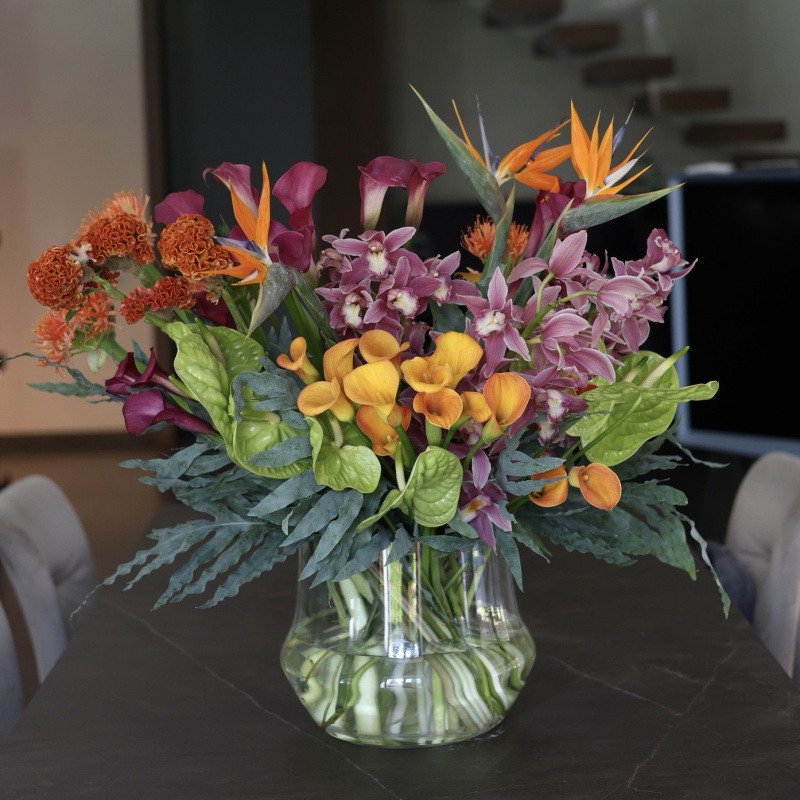
For an evening dinner, complex whites, wine, plum, brown-pink, green, and powder shades work beautifully. But the choice always depends on the interior and the overall mood.
Birthdays and private parties
It's good when the styling carries a recognisable personal note without turning into literal themed décor. A love of Italy doesn't have to be expressed with lemons and pictures of a Vespa. Sometimes it's enough to choose handmade ceramics, add olive branches, and set a relaxed rhythm along the table.
We'd be glad to be part of your event.
Galas and corporate events
That said, corporate styling needn't be impersonal. It can carry the character of a brand or an occasion through colour, form, and materials, without becoming a direct illustration of a logo.
A gala calls for stagecraft. You need to know what a guest sees on arrival, how the room will look during the welcome drinks, where people will photograph themselves, and what will appear in shot during the speeches.
If the event is tied to a brand, it's worth aligning the styling with its visual system. That doesn't mean assembling bouquets in the exact corporate shade. Sometimes it's enough to work with the overall level of contrast, the rhythm, and the character of the forms.
Events at home or out of town
Think ahead about where the team will assemble arrangements, how surfaces will be protected, what route larger structures will take through the house, and where furniture and objects can be moved temporarily.
Out of town, weather and distance come into play. Outdoors, temperature, wind, sun, and humidity all matter. Some structures need additional fixing, and the more sensitive flowers can't be left in direct sun for long. Styling outside the city also depends on the time of day. Lunch on a terrace and dinner in the same spot after sunset read as two different spaces. Sometimes the right candles and lighting are all it takes for daytime floristry to find its evening continuation.
How a project unfolds
- Understanding the briefAt the first stage we discuss the date, the format, the venue, the number of guests, an approximate budget, and the mood you're after. It helps to send photographs of the space and any references you already have.
- Visiting the venueThe team assesses dimensions, light, entrances, technical restrictions, and the installation route. Details often turn up on site that no photograph shows.
- The conceptOnce the information is gathered, a visual direction takes shape. It can include the palette, the character of the floristry, the principal forms, the types of vases, examples of texture, and ideas for the key areas. The concept exists to fix the shared language of the project.
- The estimateThe estimate connects the idea to the real volume of work. It covers flowers, greenery, plants, decorative materials, vases and structures, hire, transport, the team's work, installation, and breakdown.
- Installation and strikeInstallation happens in the window agreed with the venue. Large structures are assembled on site, arrangements are placed after the textiles and furniture, and the final details are checked before guests arrive. After the event, everything is taken down.
How flowers interact with light, textiles, and tableware?
Shades that are too close together sometimes merge – pale pink flowers can disappear against a dusty pink cloth. In that case you need a lighter, darker, or green contrast. White flowers aren't always the same white either: cool white, cream, milk, and ivory all behave differently under lighting. Warm light can turn a cool white palette yellowish, while very dark flowers lose their detail.
Glass heightens the sense of air and light. Ceramic adds materiality and intimacy. Metal reads as more formal or more contemporary. Vessels should support the concept, not compete with the flowers.
Candles help unify a table and create depth. But naked flame isn't permitted at every venue. Sometimes enclosed candles, lanterns, or electric alternatives are used instead. It's far better to learn these restrictions before developing a concept than on the day of installation.
Safety matters too. Flame shouldn't sit near dried plants, textiles, or overhanging flowers.
Seasonality and choosing flowers
Seasonal flowers often give styling a particular sense of time and place. A spring dinner with lilac or branches looks natural precisely because the material matches the moment. Summer garden flowers create a different density and mood, and autumn brings deeper shades, fruit, and expressive textures.
But seasonality shouldn't become a rigid theme. There's no need to turn an autumn event into a display of pumpkins, or a winter one into conifers and pine cones. It's far more interesting to use the season subtly: through the palette, the texture, the character of the branches, and how far the flowers have opened.
When choosing, consider not only appearance but the conditions at the venue. Some flowers are sensitive to heat, direct sun, or long periods out of water. Others hold their form well and suit large-scale structures.
Scent matters at dinner. Strongly perfumed flowers can be wonderful in an entrance area, yet compete with the food at the table. Use them especially carefully in a small, enclosed room.
A rare flower doesn't need to appear in every arrangement. Sometimes a targeted approach is stronger: a few expressive stems in the key area, and calmer floristry on the remaining tables.


Mistakes that spoil even expensive décor
- Too many ideasOne area is garden-like, another minimal, a third built on gold and candles. Separately the decisions may be beautiful; together they create visual noise.
- Copying a reference without regard for the venueReproduce a photograph from Pinterest or a magazine literally and the result can be something else entirely.
A reference should explain the mood, it isn't a technical drawing. - The same scale everywhereWhen one size is used throughout every arrangement, part of the styling looks too weak and part of it gets in the way.
- Ignoring the lightThe palette is best assessed with the time of the event and the lighting plan in mind.
- Forgetting the serviceIf the floristry blocks the waiting staff, makes it hard to set down dishes, or takes up the space meant for glasses, a beautiful table quickly becomes an irritation.
- Overpowering scentIn the dining area, fragrance should be delicate. Strongly scented arrangements are better placed at the entrance, on the staircase, or in a separate sitting room.
What's particular about events in Moscow and the Moscow region
In historic mansions, it's often forbidden to fix anything to walls, ceilings, or architectural details. Any styling has to be entirely free-standing and safe for the interior.
Restaurants run to their own schedule. Sometimes installation can only begin once the lunch service ends, and has to be finished shortly before guests arrive.
Large hotels and event spaces require team lists, equipment, unloading, and any use of naked flame to be agreed in advance.
Projects just outside the city add travel time and a dependence on the weather – particularly when the event is in a garden, on a terrace, or in a marquee.
At an outdoor venue, a contingency plan is essential. Flowers, candles, and structures either have to withstand a change in the weather or be able to move indoors quickly.Distance affects the breakdown too. If an event finishes at night, it's settled in advance when the team can collect hired items and structures.
None of these questions look creative. But they are exactly what allows a beautiful concept to happen without any fuss.
Entrust the styling of your event to Leto Flowers.
FAQ
FAQ